


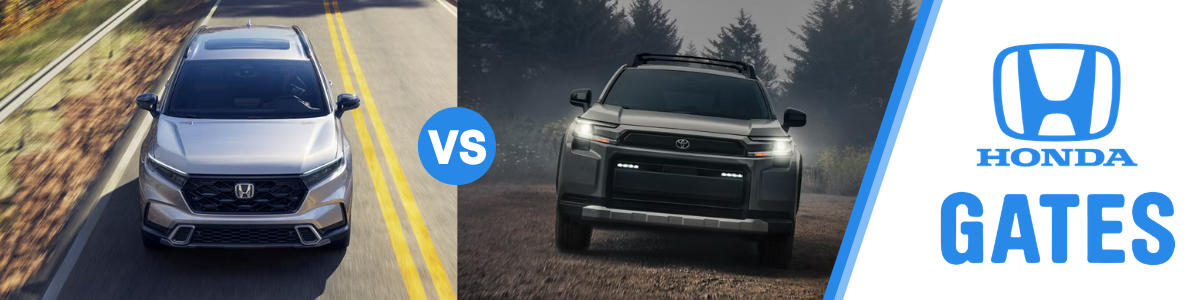
The 2026 CR-V and RAV4 Take Different Roads to the Same Driveway
Two compact SUVs top almost every shopping list, and for 2026, they couldn't be built more differently. One still sells a turbo-gas model alongside its hybrids, while the other went all in on batteries. Your week behind the wheel decides which one fits.
- The CR-V offers a turbocharged gas engine or a two-motor hybrid, while every 2026 RAV4 grade runs a hybrid or plug-in hybrid powertrain.
- Toyota wins on EPA fuel economy and towing, and Honda answers with more cargo room on its gas trims and a wireless charger on the base model.
- The trim-by-trim chart below lines up horsepower, drivetrain, EPA ratings, and tow ratings for both lineups.
Walk Around the 2026 CR-V
Before the spec charts, see the vehicle itself. This walkaround covers the cabin, the cargo hold, and the trim differences the chart below puts numbers to.
Shop CR-V inventoryPower Choices in the Honda CR-V vs. Toyota RAV4 Matchup
Both SUVs seat five and offer front- or all-wheel drive, but they split under the hood. Honda's LX, EX, and EX-L use a turbocharged 1.5-liter four-cylinder with 190 horsepower and 179 lb-ft of torque. Hybrid trims pair a 2.0-liter engine with two electric motors for 204 combined horsepower, and the drive motor's 247 lb-ft kicks in from a standstill.
Every RAV4 is electrified. Its standard hybrid makes 226 combined horsepower with front-wheel drive and 236 with all-wheel drive. Plug-in grades jump to 324 horsepower, and Toyota lists an EPA-estimated 54 miles of all-electric range on the SE. If a gas-only engine is on your wish list, the Honda CR-V vs. Toyota RAV4 decision gets simple, since only Honda still sells one.
Where Fuel Economy Lands
Toyota takes this round. Front-drive RAV4 LE, SE, and XLE Premium models are rated at 47 city and 40 highway. AWD versions range from 42 combined on the LE and SE down to 38 on the Woodland, which rides on all-terrain tires.
Honda's hybrid posts 43 city and 36 highway with front-wheel drive, or 40 and 34 with Real Time AWD. On all-terrain tires, the TrailSport Hybrid rates 35 combined. Gas trims return 28 city and 33 highway in front-drive form.
Cargo Room and Back-Seat Space
Gas CR-V trims hold 39.3 cubic feet behind the second row and 76.5 cubic feet with that row folded. Hybrid trims measure 36.3 behind the second row and the same 76.5 with it down, since the battery eats into the space under the cargo floor rather than the space above it. The Sport Touring Hybrid lists 34.7 behind the rear seat, where the Bose subwoofer takes a small bite. Rear passengers get 41 inches of legroom.
Over at Toyota, the RAV4 lists up to 37.8 cubic feet with no row-by-row breakdown. That puts the gas CR-V ahead on paper, and the hybrid CR-V a cubic foot and a half behind. Haul strollers or hockey bags? Bring them along and load both.
Towing and Bad-Weather Traction
Towing tilts hard toward Toyota. AWD RAV4 hybrids in SE, XLE Premium, Woodland, XSE, and Limited form can pull 3,500 pounds. The LE and every front-drive grade top out at 1,750 pounds.
A CR-V handles 1,500 pounds with the turbo and 1,000 with the hybrid, enough for a small utility trailer. Real Time AWD is available on every trim and standard on the TrailSport and Sport Touring Hybrid, and both of those add a four-mode drive system with a dedicated Snow setting for slick winter mornings and gravel lanes.
Safety Gear and Cabin Tech
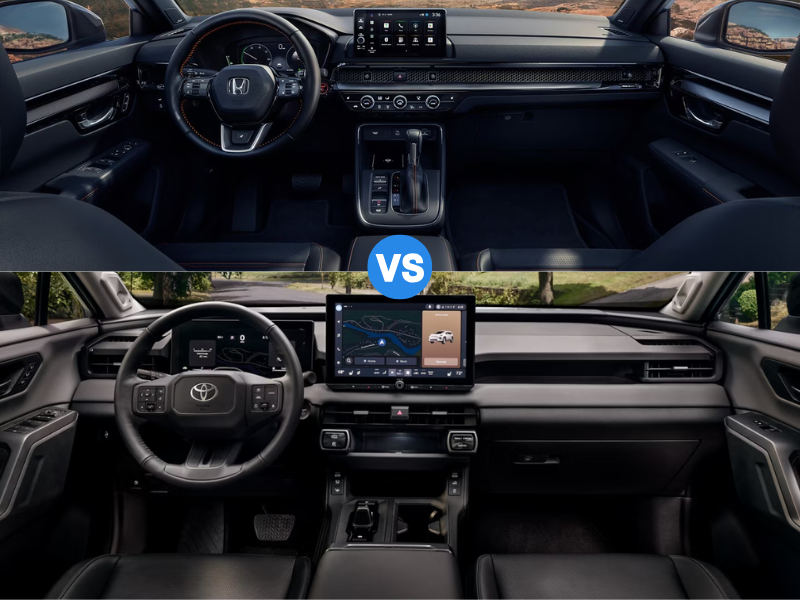
Every CR-V comes with Honda Sensing. It bundles collision-mitigation braking, adaptive cruise with low-speed follow, lane-keeping assist, and road-departure mitigation. All trims get a 9-inch touchscreen with wireless Apple CarPlay and Android Auto, and a wireless phone charger comes standard on the base LX, which is unusual at that end of the lineup.
Every RAV4 comes with Safety Sense 4.0, a 12.3-inch digital gauge cluster, and a touchscreen of at least 10.5 inches with wireless phone mirroring, so it wins on screen size. Wireless charging isn't standard on the LE or SE, though. Up top, the CR-V Sport Touring Hybrid adds a 12-speaker Bose system and Google built-in.
2026 Honda CR-V and Toyota RAV4 Trim Comparison Chart
EPA figures are estimates. Your mileage will vary.
| Trim | Powertrain | Output | Drivetrain | EPA MPG (City/Hwy/Comb) | Max Towing |
|---|---|---|---|---|---|
| Honda CR-V | |||||
| LX | 1.5L turbo 4-cylinder, CVT | 190 hp / 179 lb-ft | FWD standard, AWD available | 28/33/30 FWD 27/31/29 AWD |
1,500 lbs |
| EX | 1.5L turbo 4-cylinder, CVT | 190 hp / 179 lb-ft | FWD standard, AWD available | 28/33/30 FWD 27/31/29 AWD |
1,500 lbs |
| EX-L | 1.5L turbo 4-cylinder, CVT | 190 hp / 179 lb-ft | FWD standard, AWD available | 28/33/30 FWD 27/31/29 AWD |
1,500 lbs |
| Sport Hybrid | 2.0L Atkinson 4-cylinder, two-motor hybrid | 204 hp combined | FWD standard, AWD available | 43/36/40 FWD 40/34/37 AWD |
1,000 lbs |
| TrailSport Hybrid | 2.0L Atkinson 4-cylinder, two-motor hybrid | 204 hp combined | AWD standard | 38/33/35 | 1,000 lbs |
| Sport-L Hybrid | 2.0L Atkinson 4-cylinder, two-motor hybrid | 204 hp combined | FWD standard, AWD available | 43/36/40 FWD 40/34/37 AWD |
1,000 lbs |
| Sport Touring Hybrid | 2.0L Atkinson 4-cylinder, two-motor hybrid | 204 hp combined | AWD standard | 40/34/37 | 1,000 lbs |
| Toyota RAV4 | |||||
| LE | 2.5L 4-cylinder hybrid, eCVT | 226 hp FWD 236 hp AWD |
FWD standard, AWD available | 47/40/43 FWD 46/39/42 AWD |
1,750 lbs |
| SE | 2.5L 4-cylinder hybrid, eCVT | 226 hp FWD 236 hp AWD |
FWD standard, AWD available | 47/40/43 FWD 46/39/42 AWD |
1,750 lbs FWD 3,500 lbs AWD |
| XLE Premium | 2.5L 4-cylinder hybrid, eCVT | 226 hp FWD 236 hp AWD |
FWD standard, AWD available | 47/40/43 FWD 45/38/41 AWD |
1,750 lbs FWD 3,500 lbs AWD |
| Woodland | 2.5L 4-cylinder hybrid, eCVT | 236 hp combined | AWD standard | 41/35/38 | 3,500 lbs |
| XSE | 2.5L 4-cylinder hybrid, eCVT | 236 hp combined | AWD standard | 43/37/41 | 3,500 lbs |
| Limited | 2.5L 4-cylinder hybrid, eCVT | 236 hp combined | AWD standard | 43/37/41 | 3,500 lbs |
| Plug-in Hybrid (SE, Woodland, XSE, GR SPORT) |
2.5L 4-cylinder plug-in hybrid, eCVT | 324 hp combined | AWD standard | Up to 40 combined (SE, XSE) EPA-est. 54 mi electric range (SE) |
3,500 lbs (SE, Woodland, XSE) GR SPORT not listed |
Read it top to bottom, and a pattern pops out. Toyota owns the fuel economy and towing columns, and Honda keeps a gas engine on the menu.
Matching Each SUV to Your Routine
Go with the RAV4 if you pull a small camper or fishing boat, or if your commute is long enough that every mpg counts. A plug-in grade makes sense when you can charge at home, and your round trip fits inside its electric range.
Lean toward the CR-V if you want a gas engine, the biggest cargo hold here, or wireless charging on the base model. Gravel-road regulars should look at the TrailSport Hybrid.
Test Drive a 2026 CR-V With Gates Honda in Richmond
At Gates Honda, we'd rather you leave with the right SUV than one we talked you into. That mindset has carried our family business into its fourth generation. Our team can line up a gas CR-V and a hybrid so you can feel the difference yourself. Our Honda-certified technicians work on every Honda model, including hybrids, and our Gates Fresh Start program helps drivers with all credit backgrounds. Check your trade with our Value Your Trade tool, then stop by, and we'll hand you the keys.
Frequently Asked Questions
Which is more fuel efficient, the Honda CR-V or the Toyota RAV4?
The RAV4 holds the edge. Front-drive RAV4 LE, SE, and XLE Premium models are EPA-rated at 47 city and 40 highway, while a front-drive CR-V Hybrid is rated at 43 city and 36 highway. With all-wheel drive, RAV4 hybrids range from 42 to 38 mpg combined and CR-V hybrids from 37 to 35.
Does the 2026 Honda CR-V still come with a gas-only engine?
Yes. The CR-V LX, EX, and EX-L use a turbocharged 1.5-liter four-cylinder rated at 190 horsepower. Every 2026 RAV4 is a hybrid or plug-in hybrid, so the CR-V is the only one of the two that still offers a gas-only engine.
How much can the Honda CR-V tow compared to the Toyota RAV4?
The CR-V is rated to tow 1,500 pounds with the turbo engine and 1,000 pounds with the hybrid. All-wheel-drive RAV4 hybrids in SE, XLE Premium, Woodland, XSE, and Limited form can tow up to 3,500 pounds, while the LE and every front-drive grade are rated at 1,750 pounds.
Which compact SUV has more cargo space?
It depends on the trim. Gas CR-V trims hold 39.3 cubic feet behind the second row, and hybrid trims hold 36.3, though both reach 76.5 cubic feet with the rear seats folded. Toyota lists up to 37.8 cubic feet for the RAV4 without a row-by-row breakdown.
Does Gates Honda service hybrid CR-V models?
We do. Our Honda-certified technicians work on every Honda model, hybrids included, and use genuine Honda parts. You can book a visit with our online service scheduler or stop by our express service department for routine maintenance.
Can I trade in my current SUV toward a CR-V?
Yes. Start with the Value Your Trade tool on our website to see what your vehicle is worth, then bring it by so we can confirm the number in person. Our finance team works with drivers across all credit backgrounds, including through our Gates Fresh Start program.
Drive the Gas and the Hybrid Back-to-Back
Ten mpg and fourteen horsepower separate them, and the cargo floor sits differently in each. Tell us how you actually use the vehicle and we'll have both pulled up front.