


What a Lease Really Costs in Kentucky Compared to Buying Kentucky drivers face a lease or buy question that national articles never quite answer. This state taxes cars in its own way. Those rules can swing the math by hundreds or even thousands of dollars. Before you sign anything on a new Honda, it pays to know exactly where that money goes. Kentucky charges a 6% usage tax on the full price when you buy, but a lease spreads that tax across your monthly payments. Every driver in the state pays a yearly vehicle property tax, and that bill lands on you whether you lease or own. Buying wins on long-term cost and mileage freedom. Leasing wins on payment size and warranty coverage. Leasing vs. Buying a Car Starts With the Tax Bill Most articles about leasing vs. buying a car skip straight to the monthly payment. In Kentucky, the smarter place to start is the tax line. Buy a car here, and you'll pay a 6% usage tax on the full retail price when you register it with the county clerk. On a $35,000 Honda, that works out to $2,100 due right up front. Lease that same car, and the math changes. Kentucky's U-Drive-It program lets lease companies pay the 6% tax on your monthly payments instead of the full sticker price. Say your lease payment runs $450 a month. The tax adds about $27 to each payment, totaling roughly $972 over a 36-month term. That's less than half the tax a buyer pays. Why? You only get taxed on the part of the car you use. Leasing vs. Buying at a Glance Factor Leasing Buying Monthly payment Lower, since you cover depreciation plus interest Higher, since you cover the full vehicle price Kentucky 6% usage tax Paid a little at a time on each monthly payment Paid up front on the full purchase price Annual KY property tax You pay it as the driver, even though the lease company holds the title You pay it each year as the titled owner End of the term Return the car, buy it out, or start a fresh lease The car is yours once the loan is paid off Mileage Caps usually run 10,000 to 15,000 miles per year Drive as far as you want with zero penalties Wear and tear Fees apply for damage past normal use at turn-in Wear affects resale price, with no turn-in fees Warranty Factory coverage usually lasts the whole lease Coverage ends while you still own the vehicle Long-term cost Payments continue for as long as you keep leasing Costs drop sharply once the loan is paid off The Yearly Property Tax Both Sides Owe Kentucky also charges a yearly property tax on every car, and you pay it when you renew your tags. The state portion is 45 cents per $100 of your car's value. County and city rates get added on top. That bill still comes to you even if you lease. The lease company may hold the title, but the tax lands with the person driving the car. So while the usage tax favors leasing, the property tax treats both paths the same. When the Lease Math Wins Leasing a car vs. buying it outright makes the most sense for drivers who like a new car every few years and keep their mileage modest. Your payment stays lower. The factory warranty usually covers the whole term. Kentucky's payment-based tax setup keeps more cash in your pocket during those first three years, too. Repair bills rarely enter the picture at all. When Buying Pulls Ahead Owning rewards patience. Once the loan ends, your only regular costs are fuel, insurance, upkeep, and that yearly property tax, which shrinks as the car loses value. Drive 20,000 miles a year commuting between Richmond and Lexington? You'll blow past lease caps fast, and extra mileage fees add up quickly. One more Kentucky wrinkle applies if you buy out your lease later. The county clerk collects 6% tax again on the buyout price, so you get taxed twice on the same car. Plan to keep a car past year five? Buying from day one almost always wins. Running Your Own Numbers Before You Sign The right call on buying vs. leasing comes down to how long you keep cars and how far you drive them. Add up the tax, the payments, and the miles you put on your current car over the past year. Short-term drivers with steady mileage save real money leasing in Kentucky. Long-haul owners build equity and escape the payment cycle for good. Either way, run the full math, taxes included, before you commit. Why Buy or Lease Your Next Honda at Gates Honda At Gates Honda in Richmond, we walk shoppers through both sides of this choice every single day. Our financing team earned Honda's Council of Excellence Award for going above and beyond for customers. We'll gladly break down the Kentucky tax math on any Civic, CR-V, Accord, or Pilot you're eyeing. We work with drivers of all credit backgrounds, and our Honda specials often include lease deals and low-interest financing that tilt the numbers even further your way. Stop by our showroom or browse our inventory online. We'll help you find the path that fits your budget and your driving habits.
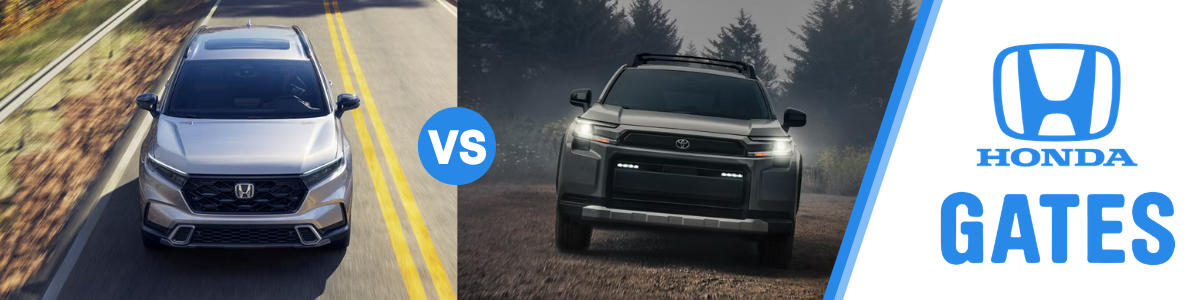
2026 Honda CR-V vs Toyota RAV4: Which Compact SUV Is Right for You?
The 2026 CR-V and RAV4 Take Different Roads to the Same Driveway Two compact SUVs top almost every shopping list, and for 2026, they couldn't be built more differently. One still sells a turbo-gas model alongside its hybrids, while the other went all in on batteries. Your week behind the wheel decides which one fits. The CR-V offers a turbocharged gas engine or a two-motor hybrid, while every 2026 RAV4 grade runs a hybrid or plug-in hybrid powertrain. Toyota wins on EPA fuel economy and towing, and Honda answers with more cargo room on its gas trims and a wireless charger on the base model. The trim-by-trim chart below lines up horsepower, drivetrain, EPA ratings, and tow ratings for both lineups. Walk Around the 2026 CR-V Before the spec charts, see the vehicle itself. This walkaround covers the cabin, the cargo hold, and the trim differences the chart below puts numbers to. Shop CR-V inventory Power Choices in the Honda CR-V vs. Toyota RAV4 Matchup Both SUVs seat five and offer front- or all-wheel drive, but they split under the hood. Honda's LX, EX, and EX-L use a turbocharged 1.5-liter four-cylinder with 190 horsepower and 179 lb-ft of torque. Hybrid trims pair a 2.0-liter engine with two electric motors for 204 combined horsepower, and the drive motor's 247 lb-ft kicks in from a standstill. Every RAV4 is electrified. Its standard hybrid makes 226 combined horsepower with front-wheel drive and 236 with all-wheel drive. Plug-in grades jump to 324 horsepower, and Toyota lists an EPA-estimated 54 miles of all-electric range on the SE. If a gas-only engine is on your wish list, the Honda CR-V vs. Toyota RAV4 decision gets simple, since only Honda still sells one. Where Fuel Economy Lands Toyota takes this round. Front-drive RAV4 LE, SE, and XLE Premium models are rated at 47 city and 40 highway. AWD versions range from 42 combined on the LE and SE down to 38 on the Woodland, which rides on all-terrain tires. Honda's hybrid posts 43 city and 36 highway with front-wheel drive, or 40 and 34 with Real Time AWD. On all-terrain tires, the TrailSport Hybrid rates 35 combined. Gas trims return 28 city and 33 highway in front-drive form. Cargo Room and Back-Seat Space Gas CR-V trims hold 39.3 cubic feet behind the second row and 76.5 cubic feet with that row folded. Hybrid trims measure 36.3 behind the second row and the same 76.5 with it down, since the battery eats into the space under the cargo floor rather than the space above it. The Sport Touring Hybrid lists 34.7 behind the rear seat, where the Bose subwoofer takes a small bite. Rear passengers get 41 inches of legroom. Over at Toyota, the RAV4 lists up to 37.8 cubic feet with no row-by-row breakdown. That puts the gas CR-V ahead on paper, and the hybrid CR-V a cubic foot and a half behind. Haul strollers or hockey bags? Bring them along and load both. Towing and Bad-Weather Traction Towing tilts hard toward Toyota. AWD RAV4 hybrids in SE, XLE Premium, Woodland, XSE, and Limited form can pull 3,500 pounds. The LE and every front-drive grade top out at 1,750 pounds. A CR-V handles 1,500 pounds with the turbo and 1,000 with the hybrid, enough for a small utility trailer. Real Time AWD is available on every trim and standard on the TrailSport and Sport Touring Hybrid, and both of those add a four-mode drive system with a dedicated Snow setting for slick winter mornings and gravel lanes. Safety Gear and Cabin Tech Every CR-V comes with Honda Sensing. It bundles collision-mitigation braking, adaptive cruise with low-speed follow, lane-keeping assist, and road-departure mitigation. All trims get a 9-inch touchscreen with wireless Apple CarPlay and Android Auto, and a wireless phone charger comes standard on the base LX, which is unusual at that end of the lineup. Every RAV4 comes with Safety Sense 4.0, a 12.3-inch digital gauge cluster, and a touchscreen of at least 10.5 inches with wireless phone mirroring, so it wins on screen size. Wireless charging isn't standard on the LE or SE, though. Up top, the CR-V Sport Touring Hybrid adds a 12-speaker Bose system and Google built-in. 2026 Honda CR-V and Toyota RAV4 Trim Comparison Chart EPA figures are estimates. Your mileage will vary. Trim Powertrain Output Drivetrain EPA MPG (City/Hwy/Comb) Max Towing Honda CR-V LX 1.5L turbo 4-cylinder, CVT 190 hp / 179 lb-ft FWD standard, AWD available 28/33/30 FWD 27/31/29 AWD 1,500 lbs EX 1.5L turbo 4-cylinder, CVT 190 hp / 179 lb-ft FWD standard, AWD available 28/33/30 FWD 27/31/29 AWD 1,500 lbs EX-L 1.5L turbo 4-cylinder, CVT 190 hp / 179 lb-ft FWD standard, AWD available 28/33/30 FWD 27/31/29 AWD 1,500 lbs Sport Hybrid 2.0L Atkinson 4-cylinder, two-motor hybrid 204 hp combined FWD standard, AWD available 43/36/40 FWD 40/34/37 AWD 1,000 lbs TrailSport Hybrid 2.0L Atkinson 4-cylinder, two-motor hybrid 204 hp combined AWD standard 38/33/35 1,000 lbs Sport-L Hybrid 2.0L Atkinson 4-cylinder, two-motor hybrid 204 hp combined FWD standard, AWD available 43/36/40 FWD 40/34/37 AWD 1,000 lbs Sport Touring Hybrid 2.0L Atkinson 4-cylinder, two-motor hybrid 204 hp combined AWD standard 40/34/37 1,000 lbs Toyota RAV4 LE 2.5L 4-cylinder hybrid, eCVT 226 hp FWD 236 hp AWD FWD standard, AWD available 47/40/43 FWD 46/39/42 AWD 1,750 lbs SE 2.5L 4-cylinder hybrid, eCVT 226 hp FWD 236 hp AWD FWD standard, AWD available 47/40/43 FWD 46/39/42 AWD 1,750 lbs FWD 3,500 lbs AWD XLE Premium 2.5L 4-cylinder hybrid, eCVT 226 hp FWD 236 hp AWD FWD standard, AWD available 47/40/43 FWD 45/38/41 AWD 1,750 lbs FWD 3,500 lbs AWD Woodland 2.5L 4-cylinder hybrid, eCVT 236 hp combined AWD standard 41/35/38 3,500 lbs XSE 2.5L 4-cylinder hybrid, eCVT 236 hp combined AWD standard 43/37/41 3,500 lbs Limited 2.5L 4-cylinder hybrid, eCVT 236 hp combined AWD standard 43/37/41 3,500 lbs Plug-in Hybrid (SE, Woodland, XSE, GR SPORT) 2.5L 4-cylinder plug-in hybrid, eCVT 324 hp combined AWD standard Up to 40 combined (SE, XSE) EPA-est. 54 mi electric range (SE) 3,500 lbs (SE, Woodland, XSE) GR SPORT not listed Read it top to bottom, and a pattern pops out. Toyota owns the fuel economy and towing columns, and Honda keeps a gas engine on the menu. Matching Each SUV to Your Routine Go with the RAV4 if you pull a small camper or fishing boat, or if your commute is long enough that every mpg counts. A plug-in grade makes sense when you can charge at home, and your round trip fits inside its electric range. Lean toward the CR-V if you want a gas engine, the biggest cargo hold here, or wireless charging on the base model. Gravel-road regulars should look at the TrailSport Hybrid. Test Drive a 2026 CR-V With Gates Honda in Richmond At Gates Honda, we'd rather you leave with the right SUV than one we talked you into. That mindset has carried our family business into its fourth generation. Our team can line up a gas CR-V and a hybrid so you can feel the difference yourself. Our Honda-certified technicians work on every Honda model, including hybrids, and our Gates Fresh Start program helps drivers with all credit backgrounds. Check your trade with our Value Your Trade tool, then stop by, and we'll hand you the keys. Frequently Asked Questions Which is more fuel efficient, the Honda CR-V or the Toyota RAV4? The RAV4 holds the edge. Front-drive RAV4 LE, SE, and XLE Premium models are EPA-rated at 47 city and 40 highway, while a front-drive CR-V Hybrid is rated at 43 city and 36 highway. With all-wheel drive, RAV4 hybrids range from 42 to 38 mpg combined and CR-V hybrids from 37 to 35. Does the 2026 Honda CR-V still come with a gas-only engine? Yes. The CR-V LX, EX, and EX-L use a turbocharged 1.5-liter four-cylinder rated at 190 horsepower. Every 2026 RAV4 is a hybrid or plug-in hybrid, so the CR-V is the only one of the two that still offers a gas-only engine. How much can the Honda CR-V tow compared to the Toyota RAV4? The CR-V is rated to tow 1,500 pounds with the turbo engine and 1,000 pounds with the hybrid. All-wheel-drive RAV4 hybrids in SE, XLE Premium, Woodland, XSE, and Limited form can tow up to 3,500 pounds, while the LE and every front-drive grade are rated at 1,750 pounds. Which compact SUV has more cargo space? It depends on the trim. Gas CR-V trims hold 39.3 cubic feet behind the second row, and hybrid trims hold 36.3, though both reach 76.5 cubic feet with the rear seats folded. Toyota lists up to 37.8 cubic feet for the RAV4 without a row-by-row breakdown. Does Gates Honda service hybrid CR-V models? We do. Our Honda-certified technicians work on every Honda model, hybrids included, and use genuine Honda parts. You can book a visit with our online service scheduler or stop by our express service department for routine maintenance. Can I trade in my current SUV toward a CR-V? Yes. Start with the Value Your Trade tool on our website to see what your vehicle is worth, then bring it by so we can confirm the number in person. Our finance team works with drivers across all credit backgrounds, including through our Gates Fresh Start program. Drive the Gas and the Hybrid Back-to-Back Ten mpg and fourteen horsepower separate them, and the cargo floor sits differently in each. Tell us how you actually use the vehicle and we'll have both pulled up front. Shop CR-V inventory Shop CR-V Hybrid